Weld Cleaning Machine Electrochemical Weld Cleaning Machine
Key Features
- Instant cleaning and polishing
- Passivation process
- Permanent marking capability
- Does not contain harmful HF acids
- Portable, lightweight and durable design
- 100% Domestic Production
- 2 Years Warranty
Product Details and Variants
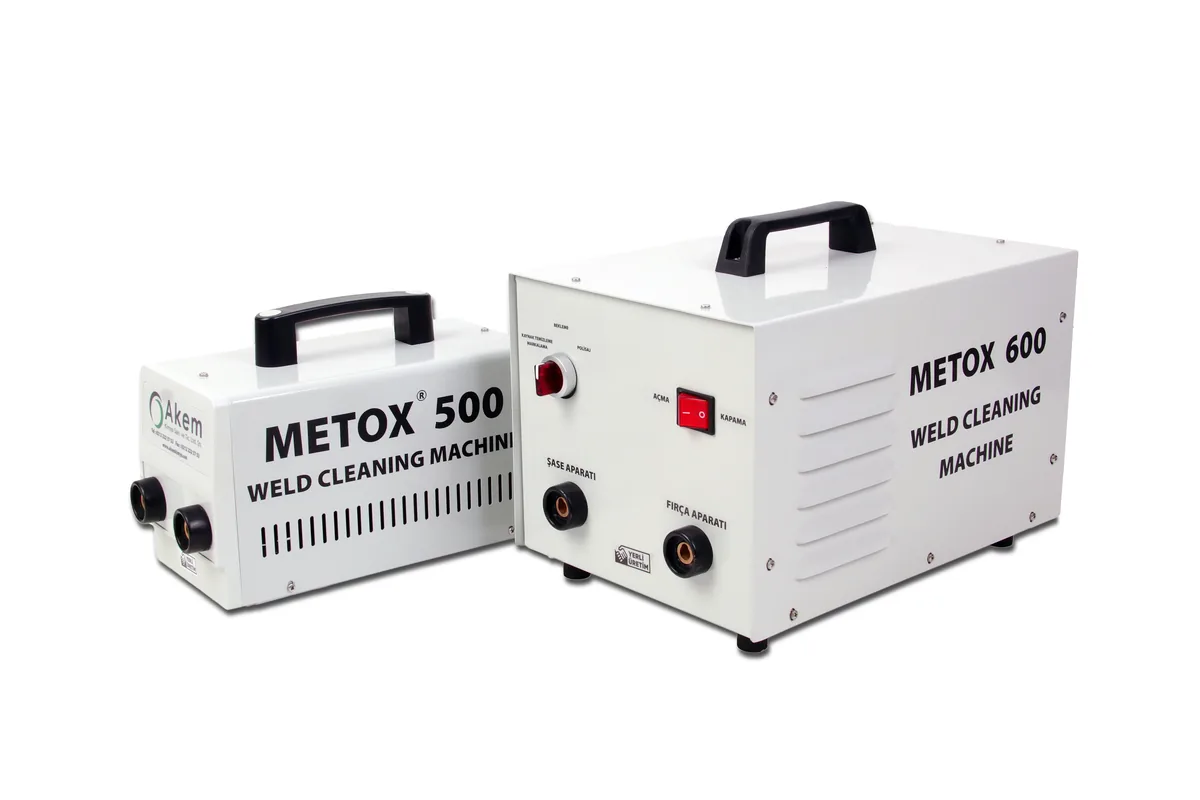
METOX 500 and METOX 600 are portable machines that remove weld marks from stainless steel surfaces by electrochemical cleaning. The same pass also passivates the surface; depending on the model, the machine performs electropolishing and marking as well.
The problem they solve is heat tint — the discolouration that appears after welding. The high temperature generated during TIG (argon) welding breaks down the chromium oxide layer that protects stainless steel, leaving a blue–purple–yellow band on either side of the weld seam. This is not only a cosmetic defect: the discoloured zone has significantly lower corrosion resistance than the rest of the material. In food, pharmaceutical, chemical and marine applications, the first corrosion always starts there.
Electrochemical cleaning removes that layer using a controlled electric current together with a weld cleaning solution — and at the same time restores the chromium oxide layer. In other words, cleaning and passivation happen in a single step.
METOX 500
METOX 500 is the base model. It has two functions:
- Weld cleaning and passivation
- Marking
It restores welded stainless steel and saves time, labour and consumables. On TIG (argon) welds it removes heat tint instantly and brings back the original colour without tone differences or dulling.
The marking system produces high-quality marks on stainless steel, galvanised steel, chrome steel, carbon steel, aluminium, brass, copper and titanium at a lower cost than laser systems.
METOX 500 technical specifications
| Specification | Value |
|---|---|
| Input power | 220 V, 50–60 Hz |
| Output | 14 V AC |
| Protection class | IP23 |
| Weight | 7.40 kg |
| Dimensions (L×W×H) | 260 × 142 × 120 mm |
| Functions | Weld cleaning · Passivation · Marking |
| Warranty | 2 years |
METOX 500 set contents
| Item | Qty |
|---|---|
| METOX 503 brush holder (1.5 m cable) | 1 |
| METOX 508 ground clamp (1.5 m cable) | 1 |
| METOX 502 carbon brush | 3 |
| METOX KTS 501 weld cleaning solution, 1 kg | 1 |
| METOX MS 505 marking solution, 1 kg | 1 |
| METOX 506 marking carbon | 1 |
| METOX 507 marking pad | 1 |
| METOX 510 marking O-ring | 2 |
METOX 600
METOX 600 is the newer model and cleans more powerfully than the METOX 500. It has three functions:
- Weld cleaning and passivation
- Electropolishing
- Marking and etching
Its instant electrochemical reaction guarantees weld mark removal and surface passivation on any stainless steel surface — without downtime, swirl marks or dulling.
Thanks to DC current it performs electropolishing within seconds. Marking is carried out with an AC reaction, etching with a DC reaction.
METOX 600 technical specifications
| Specification | Value |
|---|---|
| Input power | 220 V, 50–60 Hz |
| Output | 14 V AC/DC |
| Protection class | IP23 |
| Weight | 11.2 kg |
| Dimensions (L×W×H) | 330 × 230 × 200 mm |
| Functions | Weld cleaning · Passivation · Electropolishing · Marking · Etching |
| Warranty | 2 years |
METOX 600 set contents
| Item | Qty |
|---|---|
| METOX 503 brush holder (1.5 m cable) | 1 |
| METOX 508 ground clamp (1.5 m cable) | 1 |
| METOX 502 carbon brush | 3 |
| METOX KTS 501 weld cleaning solution, 1 kg | 1 |
| METOX POL 511 polishing solution, 1 kg | 1 |
| METOX MS 505 marking solution, 1 kg | 1 |
| METOX 506 marking carbon | 1 |
| METOX 507 marking pad | 1 |
| METOX 510 marking O-ring | 2 |
How does it work?
The process relies on an electrochemical circuit established between the carbon brush tip and the workpiece:
- Ground connection. The METOX 508 ground clamp is attached to the workpiece, completing one end of the circuit.
- Solution. The carbon brush is dipped into METOX KTS 501 weld cleaning solution, which acts as the electrolyte.
- Contact. The brush is moved along the weld seam. A low-voltage (14 V) current flows between the brush and the workpiece.
- Reaction. An instant electrochemical reaction begins at the point of contact; the thermal oxide layer dissolves and is lifted from the surface.
- Passivation. The same reaction rebuilds the chromium oxide layer on the cleaned surface.
- Rinsing. The surface is rinsed with water; a neutralising fluid is applied where required.
The most significant advantage of the method is that it does not damage the surface. Grinding removes material, leaves swirl marks and changes surface roughness; electrochemical cleaning removes only the oxide layer. There is no colour mismatch, no dulling — the original surface appearance is restored.
AC and DC operation — what each one does
The fundamental difference between the METOX 600 and the METOX 500 is that the 600 delivers both AC and DC output. They do different jobs:
AC (alternating current) — marking. Because the current alternates, the surface undergoes a colour change rather than material removal. The result is a dark mark that is not recessed into the surface. Logos, serial numbers, material grades and CE marks are applied this way — permanent, but without breaking surface integrity. Since surface roughness is unchanged, this method is preferred on food and pharmaceutical equipment.
DC (direct current) — etching and electropolishing. Because the current flows in one direction, material is removed from the surface in a controlled way. In etching, the mark is recessed into the surface and is more resistant to wear and cleaning. In electropolishing, micro-peaks are removed to produce a bright, smooth surface.
The practical benefit of electropolishing is not only visual. A smoother surface reduces bacterial adhesion and soil build-up; cleaning becomes easier and corrosion resistance increases. For this reason electropolishing is often written into specifications for food, dairy, beverage, pharmaceutical and chemical equipment.
METOX 500 vs METOX 600
| METOX 500 | METOX 600 | |
|---|---|---|
| Weld cleaning | ✓ | ✓ (more powerful) |
| Passivation | ✓ | ✓ |
| Marking (AC) | ✓ | ✓ |
| Electropolishing (DC) | — | ✓ |
| Etching (DC) | — | ✓ |
| Output | 14 V AC | 14 V AC/DC |
| Input power | 220 V, 50–60 Hz | 220 V, 50–60 Hz |
| Protection class | IP23 | IP23 |
| Weight | 7.40 kg | 11.2 kg |
| Dimensions | 260 × 142 × 120 mm | 330 × 230 × 200 mm |
| Warranty | 2 years | 2 years |
| Polishing solution included | — | ✓ (METOX POL 511) |
Which model should you choose?
Choose METOX 500 if: your requirement is limited to weld mark removal, passivation and marking; polishing is not part of your specification; portability on site is a priority (7.40 kg, carried in one hand).
Choose METOX 600 if: surface brightness and smoothness are a product requirement — food, dairy, beverage, pharmaceutical and chemical equipment, hygienic process lines; electropolishing is written into the specification; recessed (etched) marking is required; or your welding volume is high and you need stronger cleaning performance.
The decision rule: "Do I need faster weld cleaning?" If yes, choose the METOX 600.
Operating steps
- Surface preparation. Remove oil, dust and heavy soil from the area to be cleaned. The electrochemical reaction does not work properly on an oily surface.
- Ground connection. Attach the METOX 508 clamp to clean, bare metal on the workpiece. Attaching it to a painted or oxidised spot will not complete the circuit.
- Brush setup. Fit the METOX 502 carbon brush into the METOX 503 brush holder and adjust the brush length to the geometry of the job. In tight corners use the METOX 504 Teflon sleeve — it prevents short circuits and concentrates the cleaning power on a smaller, better-defined area.
- Solution. Dip the brush into METOX KTS 501 weld cleaning solution.
- Cleaning. Switch the machine on and move the brush along the weld seam with steady strokes. Do not press — contact is enough. The discolouration visibly disappears.
- Rinsing. Rinse the surface thoroughly with water. Apply a neutraliser with the METOX FPS spray bottle where required.
- Polishing (METOX 600 only). Switch to DC, use METOX POL 511 polishing solution and apply with the same technique.
- Marking (optional). Fit the METOX 506 marking carbon, place the METOX 507 marking pad and your custom marking stencil, secure with the METOX 510 O-ring, and use METOX MS 505 marking solution.
- After work. Clean the brush and accessories with water and store them dry.
For all spare parts and accessories, see the Weld Cleaning Machine — Auxiliary Equipment page.
Differences between grinding, chemical pickling and electrochemical cleaning
| Criterion | Grinding / brushing | Chemical pickling | Electrochemical (METOX 500/600) |
|---|---|---|---|
| Method | Mechanical abrasion | Acid dissolution | Controlled current + solution |
| Removes discolouration | Yes (visually) | Yes | Yes |
| Removes chromium-depleted layer | Partly — may smear it | Yes | Yes |
| Passivation | No, separate step needed | No, separate step needed | Same step |
| Surface appearance | Swirl marks, tone mismatch, dulling | Uniform matt finish | Original appearance preserved |
| Material loss | Yes | Microns | Negligible |
| Carbon steel contamination risk | Yes | No | No |
| Chemical safety | Dust and sparks | Strong acid; PPE and ventilation essential | Minimal acid use |
| Waste management | Dust | Acidic effluent — neutralisation mandatory | Limited solution waste |
| Portability | High | Low (bath / fixed plant) | High — 7.4 / 11.2 kg |
| Large surfaces | Slow | Suitable | Slow |
| Spot work / site repair | Suitable | Difficult | Most suitable |
| Recurring cost | Grinding discs | Chemicals + waste disposal | Solution + occasional brush |
Conclusion: chemical pickling suits large-surface series production; electrochemical cleaning suits spot work and on-site repair. Grinding alone is not sufficient where corrosion resistance is required.
Benefits of a weld cleaning machine
Flexibility and ease of use. Portable equipment can be used anywhere and is ideal for on-site repairs. No fixed plant, bath or crane is required.
Application safety. Safe with minimal acid use and appropriate personal protective equipment. Health risks are far lower than with gel cleaners.
Speed. Cleaning and passivation happen simultaneously; a single pass replaces two separate operations, two waiting periods and two rinses.
Optimum corrosion resistance. Passivation provides the best possible corrosion protection on the surface.
Minimum recurring cost. Operating cost is low — only weld cleaning solution (and polishing solution on the METOX 600) plus occasional brush replacement.
Which metals can it be used on?
Weld cleaning and passivation is designed for stainless steels:
| Material | Result |
|---|---|
| 304 / 304L austenitic stainless | Heat tint removed completely, full passivation |
| 316 / 316L austenitic stainless | Same; the most common application where corrosion resistance is critical |
| Duplex (2205) and super duplex | Applicable; parameters and dwell time differ from austenitic grades |
| 904L, 254 SMO | Applicable; higher alloy content extends the time required |
| Ferritic stainless (430) | Applicable |
Marking works on a far wider range of materials: stainless steel, galvanised steel, chrome steel, carbon steel, aluminium, brass, copper and titanium.
Note on aluminium: aluminium has different surface chemistry from stainless steel. It is suitable for marking, not for weld cleaning. For oxide layers and tarnishing on aluminium surfaces, use METOX AL‑04.
Frequently Asked Questions
The METOX 500 performs weld cleaning, passivation and marking (14 V AC). The METOX 600 adds electropolishing and etching (14 V AC/DC) and cleans more powerfully.
The only recurring costs are weld cleaning solution (METOX KTS 501), polishing solution (METOX POL 511) on the METOX 600, and occasional carbon brush replacement. Both solutions are available in 1 kg and 5 kg packaging.
The machine can be used by a welding operator after a short introduction. No certificate or lengthy training is needed; the operating steps are listed under the "Operating steps" heading on this page.
Weld cleaning and passivation are for stainless steels (304, 316, duplex, 904L, 254 SMO, ferritic). Marking works on stainless, galvanised, chrome steel, carbon steel, aluminium, brass, copper and titanium.
No. Electrochemical cleaning removes only the oxide layer; the original surface appearance is preserved. This is the clearest difference from grinding.
It operates on 220 V, 50–60 Hz. The wide frequency range allows use on different grids and with a suitably rated generator.
Yes. Carbon brush (METOX 502), brush holder (503), Teflon sleeve (504), ground clamp (508), power cable (509), marking carbon (506), marking pad (507) and O-ring (510) are all supplied separately.
METOX MS 505 is an electrolytic marking solution for stainless steel, mild steel, brass, copper, zinc, aluminium and titanium. It is mild, low-risk and does not cause corrosion when applied correctly. Available in 1 kg and 5 kg packaging and compatible with all machines — see the Weld Cleaning Machine — Auxiliary Equipment page.
It removes micro-peaks to create a smooth surface. Bacterial adhesion and soil build-up decrease, cleaning becomes easier and corrosion resistance improves. It is frequently a specification requirement for food, dairy, beverage, pharmaceutical and chemical equipment.
METOX 500 and METOX 600 machines carry a 2-year warranty. Spare parts and consumables are supplied continuously, independently of the warranty period.
Request a quotation for current pricing and set contents. Contact: +90 212 222 37 52 · satis@akemkimya.com.tr