PLAS P AIRCRAFT De-icing / Anti-icing Fluid for Aircraft Surfaces
Key Features
- Compliant with AMS 1424 / ISO 11075 (Type I) and AMS 1428 / ISO 11078 (Type II)
- Full compatibility with aircraft materials
- High holdover time
- Low foaming
- Thermal stability
- Easy application
Product Details and Variants
PLAS P AIRCRAFT is a monopropylene glycol (MPG) based aircraft de-icing fluid applied to aircraft fuselage and wing surfaces. The product is manufactured in two classes, Type I and Type II. The Type I formulation is based on 80–88% MPG and the Type II formulation on 50–55% MPG.
It is manufactured to international aviation specifications:
| Type | MPG content | Specifications met |
|---|---|---|
| Type I | 80 – 88% | AMS 1424 · ISO 11075 |
| Type II | 50 – 55% | AMS 1428 · ISO 11078 |
PLAS P AIRCRAFT is used at Turkish Air Force Command main jet bases, in the ground handling operations of TGS, Çelebi Aviation and Havaş, and at the UAV/UCAV production facilities of Baykar Makina and Vestel Defence.
Why is aircraft icing critical?
Icing conditions arise when the air temperature drops below freezing and atmospheric moisture turns into precipitation or condenses on the surface. Precipitation may take the form of rain, sleet or snow. Icing also occurs when fog condenses.
The point to note is this: icing can occur even when the outside air temperature is above freezing. If the aircraft surface is below freezing and there is moisture in the air, ice forms. When drizzle falls on a wing surface below 0 °C, it leaves a thin, transparent layer of ice — the hardest form of icing to detect with the naked eye.
Icing affects flight safety in two ways. The first is weight: ice, frost and snow accumulating on the surface increase the aircraft's take-off weight. The second, and more critical, is aerodynamics: even millimetre-scale roughness on the upper wing surface reduces lift and increases drag. A wing profile is an equation calculated for a clean surface; every irregularity on the surface invalidates that equation.
The rule is clear: an aircraft ready for flight must have no ice, snow, frost or slush on its critical surfaces.
The difference between de-icing and anti-icing fluid
De-icing. The process of removing ice, frost and snow already present on the aircraft fuselage and wings. A mixture of hot water and de-icing fluid is applied under pressure to the exterior of the aircraft. The task of the de-icing fluid is to remove existing contamination from the surface; it provides no subsequent protection.
Anti-icing. The process of preventing snow, frost and ice from re-accumulating on and adhering to the cleaned surface for a certain period (holdover time). Anti-icing fluid is applied either mixed with water or undiluted.
In most operations the two procedures are carried out one after the other: first the surface is cleaned by de-icing, then anti-icing provides protection until take-off. The procedures are carried out shortly before the aircraft departs, at a point close to the runway threshold.
What are Type I / II / III / IV?
Aircraft de-icing fluids are divided into four types according to their viscosity and holdover time:
| Type | Characteristics | Purpose |
|---|---|---|
| Type I | Low viscosity, transparent (usually dyed orange). Applied hot. | Removal of existing ice, frost and snow |
| Type II | Contains a (pseudoplastic) thickener; more viscous. | Combines de-icing and anti-icing functions. Remains on the surface to provide holdover time. |
| Type III | Viscosity between Type I and Type II. | For medium-sized aircraft with low take-off speeds. Medium holdover time. |
| Type IV | High viscosity, usually dyed green. Applied cold. | Longest holdover time. Prevents re-icing of the surface until take-off. |
The working principle of Type II and Type IV fluids is pseudoplastic behaviour: while the aircraft is parked, the fluid stays on the wing as a thick, non-flowing film. During the take-off run, the shear force created by the airflow over the wing reduces the viscosity, and the fluid flows off the surface, leaving a clean wing. For this reason, Type II and IV fluids are used only on aircraft that reach a sufficient take-off speed.
PLAS P AIRCRAFT is manufactured in the Type I (80–88% MPG) and Type II (50–55% MPG) classes. The type to be used is determined together with the aircraft manufacturer's procedure, the airport's winter operations instructions and the prevailing weather conditions.
AMS 1424, AMS 1428, ISO 11075 and ISO 11078
| Specification | Issued by | Scope |
|---|---|---|
| AMS 1424 | SAE International | Type I aircraft de-icing fluids |
| AMS 1428 | SAE International | Type II / III / IV aircraft de-icing / anti-icing fluids |
| ISO 11075 | ISO | Type I aircraft de-icing / anti-icing fluids (ISO Type I) |
| ISO 11078 | ISO | Type II / III / IV aircraft de-icing / anti-icing fluids |
These specifications test not only the product's de-icing performance but also its compatibility with every material on the aircraft:
- Corrosion of aluminium and aluminium alloys
- Sandwich (galvanic) corrosion
- Cadmium and titanium compatibility
- Effect on aircraft paint and coatings
- Acrylic (cockpit window) crazing test
- Elastomer seal and hose compatibility
- Aerodynamic acceptance (flow-off) test
- Water spray endurance (WSET) and high humidity endurance tests
- Stability, storage and pH behaviour
This is why the difference between an "aircraft de-icer" and a "road de-icer" is not just price but an entirely different acceptance regime.
Holdover Time
Holdover time (HOT) is the estimated time, from the moment of application on the aircraft surface, during which the anti-icing fluid can prevent renewed ice/snow accumulation on the surface. When the time expires, protection is considered to have ended, and the treatment is repeated if the aircraft has not taken off.
HOT is not a fixed value. It depends on all of the following variables at once:
| Variable | Effect |
|---|---|
| Fluid type | Type IV > Type II > Type III > Type I |
| Fluid/water mixing ratio | The higher the concentration, the longer the time |
| Precipitation type | Snow, sleet, freezing drizzle — each in a different table |
| Precipitation intensity | Light / moderate / heavy |
| Outside air temperature (OAT) | The lower the temperature, the shorter the time |
| Wind and jet blast | Mechanically thins the film |
| Aircraft skin temperature | A wing cold-soaked by cold fuel shortens the time |
HOT tables are published for each winter season by SAE and the competent aviation authorities. The value read from the table is an estimate, not a guarantee; final responsibility lies with the pre-take-off contamination check carried out by the pilot-in-command.
Operational rule: if take-off has not taken place as the lower HOT limit approaches, the pre-take-off check is renewed.
Technical properties
| Property | Value |
|---|---|
| Product type | Type I and Type II aircraft de-icing / anti-icing fluid |
| Base | Monopropylene glycol (MPG) |
| Type I formulation | 80 – 88% MPG |
| Type II formulation | 50 – 55% MPG |
| Specifications | AMS 1424 · AMS 1428 · ISO 11075 · ISO 11078 |
| Corrosion inhibitors | Formulated to protect aircraft metals |
| Thickeners (Type II) | Provide adhesion to the surface and holdover time |
| Water content | Supplied in concentrated or diluted form |
| Shelf life | 24 months |
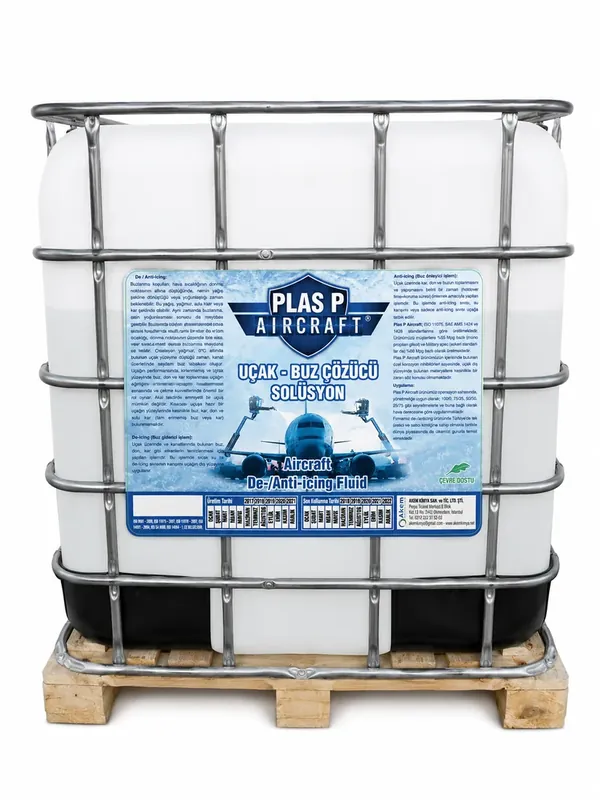
| Packaging | 60 kg jerrycan · 200 kg drum · 1,000 kg IBC tank |
Why propylene glycol? Ethylene glycol (MEG) performs similarly in terms of heat transfer but is toxic. Propylene glycol (MPG) has significantly lower toxicity with regard to airport runoff and ground staff exposure. This is why MPG-based formulations have become the standard in civil aviation.
Dilution and application
For de-icing, the fluid is mixed with hot water — the heat accelerates the mechanical removal of ice. For anti-icing, the fluid is applied cold, either undiluted or mixed with a small proportion of water.
The mixing ratio is selected according to the outside air temperature and the expected holdover time. General principle: the lower the temperature and the heavier the precipitation, the higher the proportion of fluid in the mixture. The freezing point of the mixture is set at least 10 °C below the outside air temperature (buffer rule).
Application is carried out with the airport's de-icing vehicles, in accordance with the winter operations instructions of the competent aviation authority. The critical surfaces (upper wing surface, horizontal and vertical stabilisers, upper fuselage) are covered completely; engine inlets, pitot tubes, static ports and sensor areas are protected according to the procedure.
Material compatibility
| Material | Status |
|---|---|
| Aluminium and its alloys | Protected by corrosion inhibitors; subject to AMS/ISO corrosion tests |
| Composite fuselage panels | Compatibility tested within the scope of the specification |
| Paint and coatings | No softening, blistering or discolouration of aircraft paint |
| Acrylic surfaces (cockpit windows) | Subject to crazing test |
| Elastomer seals and hoses | Subject to swelling and hardening tests |
| Cadmium-plated fasteners | Covered by the sandwich corrosion test |
Areas of use
- Commercial airliners — pre-departure de-icing and anti-icing
- Military air bases and main jet base commands
- UAV / UCAV production, test and operation facilities
- Cargo airline operations
- Business jet and general aviation terminals (FBO)
- Aviation schools and training fleets
- Helicopter operations
Users
- Turkish Air Force Command — Main Jet Bases
- TGS (Turkish Ground Services)
- Çelebi Aviation
- Havaş
- Baykar Makina — UAV / UCAV production
- Vestel Defence
- U.S.A. Air Force Base — Afghanistan
The product is supplied in the Type I (80–88% MPG) or Type II (50–55% MPG) formulation according to the user's type of operation.
Quick Action
Request a quote now to get detailed information, request technical specifications or place an order for this product.
Product Details and Variants
Product Category
You can request MSDS and TDS documents from our technical documents page.
PLAS P AIRCRAFT — Frequently Asked Questions
The product is manufactured in two classes, Type I and Type II. The Type I formulation is based on 80–88% MPG and is manufactured to the AMS 1424 and ISO 11075 specifications; the Type II formulation is based on 50–55% MPG and is manufactured to the AMS 1428 and ISO 11078 specifications.
Monopropylene glycol (MPG). The Type I formulation is based on 80–88% MPG and the Type II formulation on 50–55% MPG.
De-icing is the removal of ice, frost and snow already present on the surface; it provides no subsequent protection. Anti-icing is the protective application that prevents re-icing on the cleaned surface for a certain period (holdover time).
There is no fixed value. It is determined by the fluid type, mixing ratio, precipitation type and intensity, outside air temperature and wind together. The time is read from the published HOT tables for the current season and is an estimate — the final decision rests with the pre-take-off contamination check.
Propylene glycol has significantly lower toxicity. Considering airport runoff and ground staff exposure, MPG-based formulations are the standard in civil aviation.
No. The AMS 1424 / 1428 and ISO 11075 / 11078 specifications test compatibility with paint, coatings, composites, acrylics and elastomers under separate test headings.
No. Road de-icers are chloride-based and initiate pitting corrosion in aircraft aluminium. Aircraft fluids are subject to a separate specification and acceptance regime.
It can be supplied in concentrated or diluted form. The mixing ratio is determined according to the outside air temperature; the freezing point of the mixture is kept at least 10 °C below the outside air temperature.
24 months. Store the product in its closed packaging in a cool, dry place away from direct sunlight.
It is available in 60 kg jerrycans, 200 kg drums and 1,000 kg IBC tanks.