De-icing and anti-icing concepts.
PLAS P AIRCRAFT — Other Pages
Product Category
What Is PLAS P AIRCRAFT?
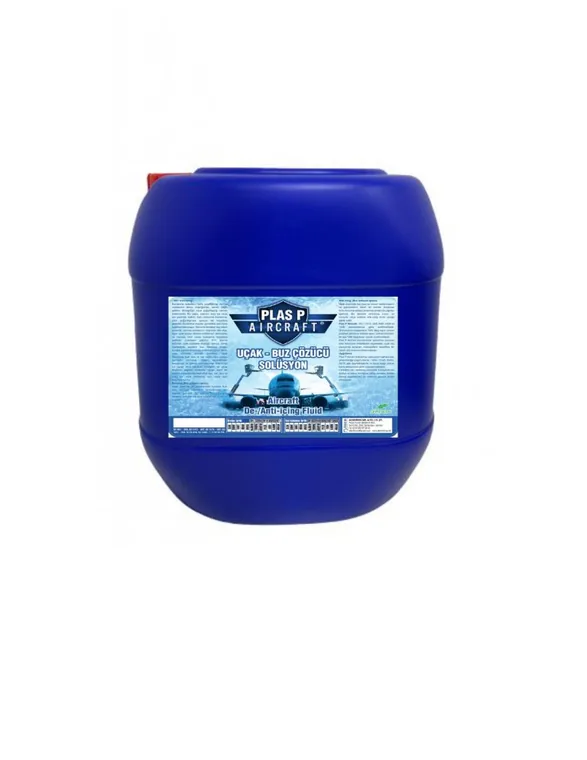
Aircraft De-icing Fluids
Icing conditions can be expected when the air temperature falls below freezing and moisture turns into precipitation or condenses. This precipitation may be in the form of rain, sleet or snow. Icing can also occur as a result of fog condensing. Icing events usually occur in severe weather conditions. However, even if the outside air temperature is above freezing, icing can occur if the aircraft surface is below freezing and there is moisture in the air. When drizzle falls on an aircraft surface below 0 °C, a transparent layer of ice forms on the wings.
Uncontaminated, clean aircraft surfaces are very important for aircraft performance. Ice, frost and snow accumulating on the aircraft surface increase the aircraft's weight and play a significant role during take-off and in the drag forces. Otherwise, a safe flight is not possible.
In short, an aircraft ready for flight must have absolutely no ice, snow, frost or slush (partially melted ice or snow) on its surfaces.
De-icing
The process carried out to remove contaminants such as ice, frost and snow from the aircraft and its wings. In this process, a mixture of hot water and de-icing fluid is applied to the exterior of the aircraft.
De-icing fluid is not used to protect the exterior of the aircraft against ice, frost, snow and similar contaminants.
Anti-icing
The process carried out to prevent snow, frost and ice from accumulating on and adhering to the aircraft for a certain time (holdover time). In this process, anti-icing fluid — either mixed with water or anti-icing fluid alone — is applied to the aircraft.
Types of Fluid Used in the Process
- Type I: Transparent. Applied hot. Intended to remove existing snow and ice.
- Type II: Thicker; provides protection on the surface for longer.
- Type III: Suitable for medium-sized aircraft; medium holdover time.
- Type IV: Usually green. Thick. Applied cold and prevents icing of the surface until the aircraft takes off.
These procedures are carried out shortly before the aircraft takes off, at a point close to the runway threshold.