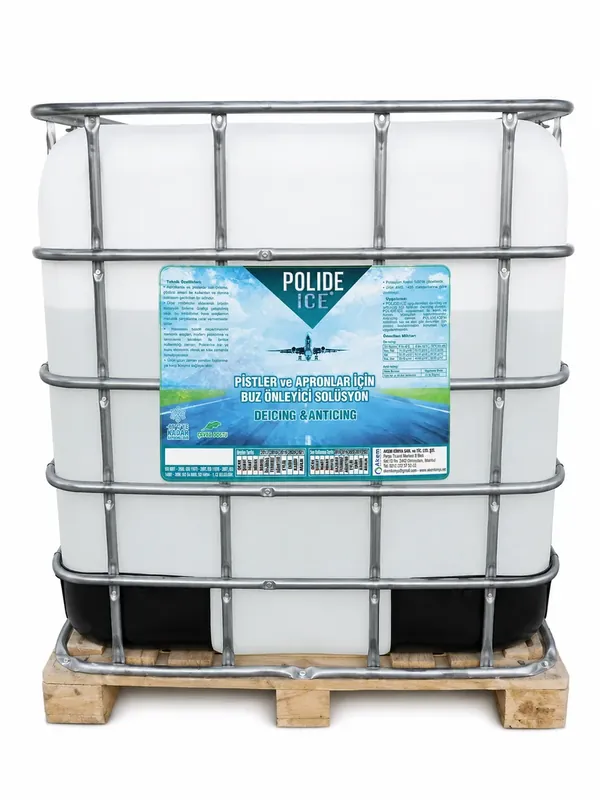
POLIDE ICE Potassium Acetate-Based Airport Runway De-icer
Key Features
- Compliant with AMS 1435 specifications
- −50 °C freezing point
- Fast action
- Low biological oxygen demand (BOD)
- Non-toxic and harmless to the environment
- Does not cause corrosion of aircraft metals
- Does not damage runway lighting fixtures
Product Details and Variants
POLIDE ICE is a potassium acetate-based liquid runway de-icer used on airport runways, taxiways and aprons. It contains approximately 50% potassium acetate, is alkali-buffered and is manufactured to the AMS 1435 specification.
A runway de-icer is a different product from a road de-icer and carries a different responsibility. On a road, a de-icer that acts late slows traffic; on a runway, the same delay directly affects take-off and braking distance. Aviation de-icers must therefore not only melt ice but also be compatible with the aluminium and composite airframe materials, carbon brakes, runway lighting fixtures and ILS equipment.
POLIDE ICE is used at airports throughout Türkiye operated by DHMİ (General Directorate of State Airports Authority), at TAV's airports abroad and at Turkish Air Force main jet bases.
Why potassium acetate?
Chloride-based de-icers cannot be used on airport runways. The reason, in one sentence: chloride damages aircraft aluminium and carbon brake systems. When road salt is used on a runway, it is carried onto the landing gear, the underside of the fuselage and the brake pack; the chloride ion initiates pitting corrosion in aluminium and accelerates oxidation in carbon brakes. This is why civil aviation authorities around the world have banned the use of chloride on runways.
Historically, the alternatives to chloride have fallen into three groups:
Urea. It is cheap and readily available but has two major problems. First, it rapidly loses its effectiveness below approximately −4 °C — that is, it does not work at the temperatures at which a de-icer is really needed. Second, it breaks down into ammonia and creates a serious nitrogen load in runoff. The use of urea at airports is restricted in many countries.
Glycols. They are used in de-icing fluids applied to airframes (PLAS P AIRCRAFT), but when applied to the runway surface they create slipperiness and lower the friction coefficient. They are not preferred on runway surfaces.
Potassium acetate. The solution that has become the standard runway de-icer in aviation:
- High low-temperature performance. The freezing point of POLIDE ICE is below −50 °C. Urea comes nowhere near this value.
- Chloride-free. There is no chloride-related corrosion risk for aircraft aluminium or carbon brake systems.
- Maintains the friction coefficient. Applied at the correct dosage, it does not make the runway surface slippery.
- Low environmental load. Its BOD (biological oxygen demand) and COD (chemical oxygen demand) values are low compared with urea; the product is readily biodegradable.
- Free of triazole and nitrite. These two groups of substances are specifically scrutinised in airport discharge regulations and in carbon brake compatibility.
Technical properties
| Property | Value | What it means |
|---|---|---|
| Product type | Runway de-icer / anti-icing fluid | Used for both de-icing and anti-icing |
| Active substance | Approx. 50% potassium acetate | Chloride-free |
| Standard | AMS 1435 | Aviation specification for liquid runway de-icers |
| Appearance | Clear, colourless liquid | Causes no discolouration of runway markings or fixtures |
| Freezing point | < −50 °C | Does not freeze under any airport conditions in Türkiye |
| Density (20 °C) | 1.25 – 1.35 g/cm³ | Used for dosage and tank capacity calculations |
| pH | 9.0 – 11.0 (alkali-buffered) | Buffering eliminates the risk of acidic corrosion |
| Flash point | None (non-flammable) | Not subject to flammable liquid storage regulations |
| Viscosity | Low — easily sprayed | Compatible with the nozzles of existing de-icing vehicles |
| BOD / COD | Low | Limits the airport discharge load |
| Free of | Triazole, nitrite, chloride, urea | Critical for carbon brakes and discharge regulations |
| Biodegradation | Readily biodegradable | Makes waste management easier |
De-icing and anti-icing application
De-icing is the melting process carried out after ice, snow or frost has formed on the runway surface.
Anti-icing is the protective process carried out before ice forms, when precipitation or frost is expected.
In airport operations, anti-icing means not only chemical savings but also shorter runway closure times. On a pre-treated runway, snow clearing is completed in a single pass; on a runway where ice has formed, the same job requires several passes and a longer closure.
POLIDE ICE is sprayed with the airport's existing de-icing vehicles. No separate investment in equipment is required.
De-icing application table
| Surface condition | 0 to −5 °C | −5 to −10 °C | Below −10 °C |
|---|---|---|---|
| Ice, drifting snow | 10 – 20 g/m² | 20 – 30 g/m² | 30 – 40 g/m² |
| Snow | 25 – 35 g/m² | 35 – 45 g/m² | 45 – 55 g/m² |
| Ice, frost | 30 – 40 g/m² | 40 – 50 g/m² | 50 – 60 g/m² |
Anti-icing application table
| Weather condition | Application rate |
|---|---|
| Sleet or frost expected | 20 – 30 g/m² |
Reading the difference in the table is decisive for operational planning: a frost layer formed below −10 °C requires up to 60 g/m² of product, whereas anti-icing carried out beforehand under the same conditions works with 20–30 g/m². Preventive treatment halves chemical consumption.
Runway safety and material compatibility
Friction coefficient. The friction coefficient of the runway surface directly determines the aircraft's braking distance. Applied at the recommended rates, POLIDE ICE does not make the surface slippery. Overdosing causes a temporary drop in friction with any de-icer; the table values should therefore not be exceeded.
Aircraft metals. The product is chloride-free. It poses no risk of chloride-related pitting corrosion on aluminium fuselage panels, landing gear components or cadmium-plated fasteners.
Carbon brakes. Modern commercial aircraft use carbon brake discs, which are sensitive to catalytic oxidation at high temperatures. In potassium acetate-based formulations, this risk is kept under control by the product's buffering and additive package. POLIDE ICE is free of triazole and nitrite.
Runway lighting and fixtures. The product is clear and colourless; it causes no discolouration or film build-up on inset runway light lenses.
Concrete and asphalt runway surfaces. Because it is alkali-buffered, it causes no acidic attack on concrete runway surfaces.
Areas of use
- Commercial airport runways
- Taxiways
- Aprons and aircraft stands
- Military air bases and main jet base commands
- Heliports and hospital helipads
- Airside service roads and refuelling areas
- Aviation schools and training airfields
Airport references
- TAV Macedonia — Skopje and Ohrid Airports
- TAV Georgia — Tbilisi and Batumi Airports
- DHMİ — airports throughout Türkiye
- Anadolu University Faculty of Aeronautics and Astronautics — Eskişehir Hasan Polatkan Airport
- Turkish Air Force — various Main Jet Base Commands
POLIDE ICE has been used over several winter seasons at some of the airports listed. Reference letters and product conformity documents for tender files are available on request.
Quick Action
Request a quote now to get detailed information, request technical specifications or place an order for this product.
Product Details and Variants
Product Category
You can request MSDS and TDS documents from our technical documents page.
POLIDE ICE — Frequently Asked Questions
It is manufactured to the AMS 1435 standard.
Approximately 50% potassium acetate. The product contains no chloride, urea, triazole or nitrite.
Its freezing point is below −50 °C. The application rate is selected from the table according to temperature.
Chloride initiates pitting corrosion in aircraft aluminium and accelerates oxidation in carbon brake systems. This is why chloride-based de-icers are not used on runways.
Urea loses its effectiveness below approximately −4 °C and, when it breaks down, turns into ammonia, creating a high nitrogen load in runoff. Potassium acetate works at much lower temperatures and has a low environmental load.
Applied at the recommended rates, it does not lower the friction coefficient. The table values should not be exceeded.
It is sprayed with the airport's existing de-icing vehicles; no additional investment in equipment is needed.
The product is free of triazole and nitrite and is alkali-buffered; the formulation has been prepared with carbon brake compatibility in mind.
It is stored in its closed packaging with no risk of freezing — the product's own freezing point is below −50 °C.
It is available in 60 kg jerrycans, 1,000 kg IBC tanks and 1,250 kg IBC tanks.